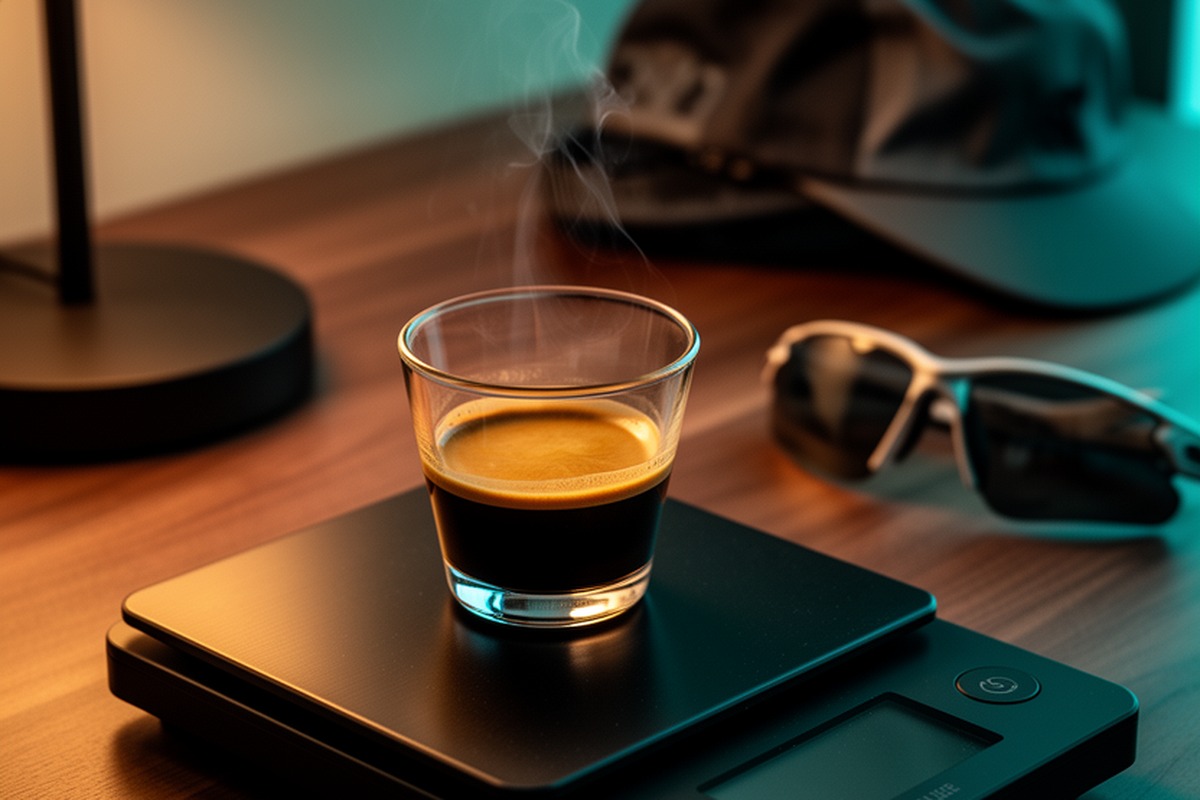
In 2012, researchers at the University of Glasgow bought twenty espressos from twenty cafés and ran them through an HPLC column. Same drink, same city, same order at the counter. The caffeine in a single serving ranged from 51 mg to 322 mg — a six-fold spread, mostly explained by how much coffee each barista decided to put in the basket (Crozier et al., Food & Function, 2012).
Hold that number next to the way cyclists talk about caffeine. We talk about it like a drug, because the evidence says we can: milligrams per kilogram, minutes before the start, a percentage on the other side. Then we deliver it in the least standardized vehicle in the kitchen and call the job done.
The protocol is real, and it is specific
Caffeine is one of the few legal ergogenic aids with evidence strong enough to be boring. The International Society of Sports Nutrition’s 2021 position stand puts the effective range at 3–6 mg per kilogram of body mass, most commonly taken 60 minutes before exercise, with aerobic endurance the discipline showing the most consistent moderate-to-large benefit — on the order of 2–4% (Guest et al., JISSN, 2021).
Two to four percent is not a rounding error over four hours. It is the difference between sitting in and getting shelled.
The stand is equally specific about the edges. Below roughly 2 mg/kg the effect gets unreliable. Around 9 mg/kg you mostly buy side effects. Plasma caffeine peaks anywhere from 30 to 120 minutes after you swallow it, which is why “an hour before” is a convention rather than a law — and why the tidy “peaks at 45 minutes” figure you’ll find in most cycling blogs (including, in a looser moment, our own) is really the middle of a wide, person-shaped window.
For a 70 kg rider, 3–6 mg/kg is 210 to 420 mg. Now go back to Glasgow. One espresso could be 51 mg. One espresso could be 322 mg. The protocol has a target; the cup has a lottery.
Two to four cups. Not one shot.
This is the part that tends to land badly with people who take their coffee seriously. The ISSN published a second position stand in 2023, this one specifically on coffee, and it did the arithmetic most of us avoid: to reach a caffeine-equivalent dose of 3–6 mg/kg, you are looking at two to four cups — roughly 473 to 946 ml — of typical hot-brewed or instant coffee, 60 minutes before you ride (Lowery et al., JISSN, 2023).
Half a litre to a litre. The single ceremonial shot standing over the top tube, the one that photographs so well, is for most riders a sub-threshold dose dressed up as a protocol.
The same stand offers the consolation: coffee works. When the caffeine dose is matched, finishing times after coffee and after anhydrous caffeine in a capsule show no significant difference. The capsule is not magic. It is merely legible. Its only real advantage over your moka pot is that it knows what it weighs.
What actually moves the number
Grind, bean, and brew all matter, but the Glasgow data points at the dominant variable first: the mass of coffee in the basket. Batch-to-batch bean composition, arabica versus robusta, roast and grind all contribute — but the predominant factor, the authors concluded, is simply how much coffee went in.
That is unusually good news, because dose is the one input you can control before 6 a.m. without owning a laboratory. If you know your grams in, you know roughly your milligrams out, and you can stop guessing.
A workable pre-ride routine, then, is less about the perfect bean than about repeatability:
- Weigh the beans. Same dose, same grinder setting, same brew. A scale converts “one espresso” from an anecdote into a number.
- Do the multiplication once. Body mass × 3 to 6. Write it on the inside of a cupboard door. For most riders the honest answer is more coffee than I am currently drinking, or a second cup.
- Give it an hour. Not twenty minutes in the car park. The 60-minute convention exists because the peak is slow and variable.
- Never on race morning. Rehearse the dose on a training ride, twice, before you trust it on a day that matters.
The caveats are not small print
Caffeine’s response curve is genuinely personal, and the genetics are not folklore. In the literature the ISSN reviews, riders carrying the AA variant of CYP1A2 — the fast metabolizers — improved by around 6.8%. Riders with the CC variant, given the same 4 mg/kg, saw performance impaired by 13.7%. Same dose, opposite sign. Carriers of the TT variant of ADORA2A tend to be the ones for whom caffeine mostly delivers anxiety.
There is a ceiling, too. The European Food Safety Authority’s 2015 opinion puts habitual intake at up to 400 mg a day and single doses at up to 200 mg without safety concerns for healthy non-pregnant adults, and notes the same single dose is fine within two hours of intense exercise (EFSA, 2015).
Read those two paragraphs together and the tension is obvious: a full 6 mg/kg ergogenic dose for an 80 kg rider is 480 mg — comfortably above what EFSA calls a routine single serving. Sports-nutrition ceilings and food-safety ceilings are answering different questions, and where they overlap is exactly where an honest guide has to stop and say: this is a decision, not a recipe. Start at 3 mg/kg. See what your gut and your sleep say. Most riders never need the top of the range.
The point
None of this is an argument against the ritual. The moka pot on the hob at 5 a.m. is still the best part of the day, and the café stop at kilometre 60 is still the reason half of us ride at all.
It is an argument for knowing what is in the cup. Caffeine is the most reliably performance-enhancing thing most of us will ever legally consume, and we have spent a decade optimising tyre pressure to two decimal places while treating its dose as a vibe. The gear that fixes it costs less than a pair of bar tape rolls, and it is a scale.
Cadence is rhythm. Crema is proof of care. Care, here, means weighing it.
Sources. Crozier TWM, Stalmach A, Lean MEJ, Crozier A. “Espresso coffees, caffeine and chlorogenic acid intake: potential health implications.” Food & Function 3(1):30–33, 2012 — HPLC analysis of 20 commercial espressos, caffeine 51–322 mg/serving. Guest NS et al. “ISSN position stand: caffeine and exercise performance.” JISSN 18:1, 2021 — 3–6 mg/kg, 60 min pre-exercise, Tmax 30–120 min, CYP1A2/ADORA2A variation. Lowery LM et al. “ISSN position stand: coffee and sports performance.” JISSN 20(1):2237952, 2023 — 2–4 cups (473–946 ml) for a 3–6 mg/kg equivalent; coffee vs. anhydrous caffeine equivalence. EFSA NDA Panel, “Scientific Opinion on the safety of caffeine,” EFSA Journal 13(5):4102, 2015 — 400 mg/day habitual, 200 mg single dose. The 51–322 mg range comes from twenty espressos in one city in 2012; treat it as evidence that the spread is large, not as a table of what any given café pulls today.