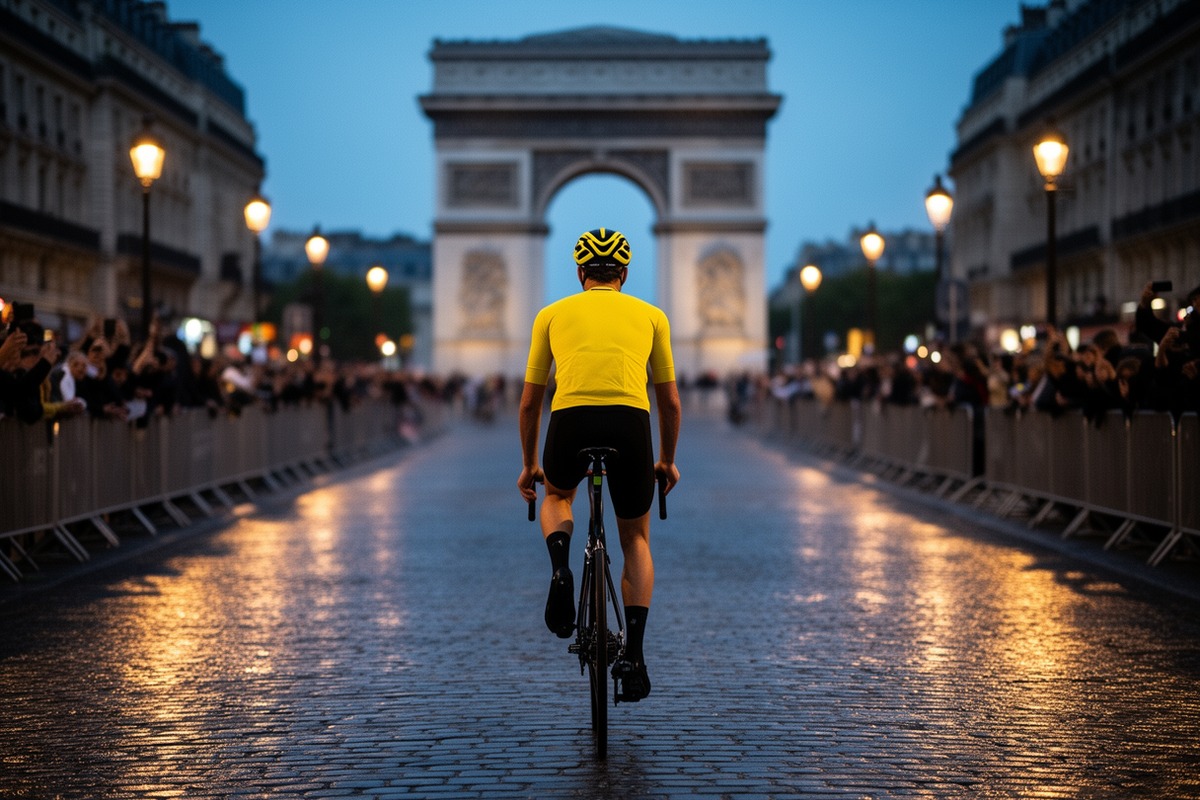
The last stage of the 2026 Tour de France began with an absence.
There was no racing out of Thoiry. Wildfires in southwest France had pulled security forces away from the Tour, so organizers cut stage 21 from 133 kilometers to 89 and moved the official start onto the Champs-Élysées. The presentation still happened in Thoiry; the riders took buses to Paris. The celebration, and then the fight, began there.
It became a better bike race than the traditional procession had any right to be.
Mathieu van der Poel attacked on the final ascent of the cobbled Butte Montmartre, and Tadej Pogačar followed. Pogačar, already wearing the yellow jersey he was about to keep, still had the appetite to race. The pair drove the move together before Van der Poel accelerated alone with 600 meters left as Pogačar faded. Jasper Philipsen and Mads Pedersen came rushing back on the Champs-Élysées, but Van der Poel held them off by inches.
Van der Poel won Paris. Pogačar won history.
Five
Pogačar’s fifth Tour puts him beside Jacques Anquetil, Eddy Merckx, Bernard Hinault and Miguel Induráin. He has now ridden seven Tours, stood on the podium in all seven and won five of them: 2020, 2021, 2024, 2025 and 2026.
This one ended with a margin of 6:26 over Remco Evenepoel. Isaac del Toro, Pogačar’s 22-year-old teammate, finished third at 9:42 and took the white jersey. Mads Pedersen won green. Richard Carapaz won the mountains classification and the Tour’s super-combativity award.
The numbers are clean. The race was not.
Jonas Vingegaard, the only rider who has beaten Pogačar at the Tour, crashed out on stage 15 with a broken collarbone. Evenepoel improved and finished a clear second, but never reduced the contest to a final-day uncertainty. Del Toro’s podium was extraordinary; it was also secured in the gravitational field of the strongest rider and team in the race.
Pogačar won five stages. The fifth came on Alpe d’Huez on stage 19, where he broke the climbing benchmark associated with Marco Pantani. It was the kind of performance that makes every ordinary description—dominant, historic, unprecedented—feel worn out before the sentence ends.
And then, two days later, with the overall classification already settled and the timing neutralized before the Montmartre circuits, he attacked Van der Poel on cobbles anyway.
That is the detail that matters.
The whole Tour in one attack
This Tour began in Barcelona and spent three weeks turning possibilities into arithmetic. Pogačar won at Les Angles on stage 3, on the Tourmalet stage to Gavarnie-Gèdre on stage 6, at Le Lioran on Bastille Day, and at Le Markstein on stage 14 before the Alpe d’Huez record made five.
The first half still produced resistance. There were boos at Le Lioran. Vingegaard remained the one rival with a Tour-winning history against him. Evenepoel had the time trial and the belief. Young riders—Del Toro, Paul Seixas, Juan Ayuso—made the podium and white-jersey fights worth watching.
But the center of the race never moved. Teams could change the terrain, isolate his helpers, send riders up the road or wait for altitude and fatigue to collect their debt. Pogačar kept arriving with another acceleration.
That is why the final attack in Paris was not exhibition riding. It was the Tour reduced to its essential image: the yellow jersey behaving as if there were still something to win.
Van der Poel was the perfect rider to deny him. He is one of the few men in cycling whose presence can change the terms of a race rather than merely survive them. On Montmartre, the greatest stage racer of this generation met its greatest Classics rider. Van der Poel had the final punch. Pogačar had the fifth yellow jersey.
Both outcomes felt right.
The greatest, already
Eddy Merckx still owns the résumé nobody can sensibly reproduce: 525 victories by the widely used count, 11 Grand Tours, all five Monuments and an appetite so complete that cycling made “the Cannibal” a permanent category.
If greatest means the largest ledger, the argument remains Merckx’s. It may remain his forever.
But ledgers are not the only way we compare athletes across eras. Modern cycling is narrower, more specialized and more optimized. Grand Tour leaders are supposed to build seasons around Grand Tours. Classics stars are supposed to peak for one-day violence. Time trialists, climbers and sprinters live in different tactical ecosystems.
Pogačar keeps crossing those borders.
He has won the Tour of Flanders, Liège–Bastogne–Liège, Il Lombardia, Milan–San Remo, the Giro d’Italia, the world road title and now five Tours de France. He wins summit finishes and cobbled Classics. He can attack from distance, win against the clock and still make the final stage in Paris harder when he has nothing left to prove.
So here is the opinion, stated plainly: Tadej Pogačar is already the greatest cyclist of all time.
Not because Merckx’s record has become smaller. It has not. Not because five Tours ends every comparison. Anquetil, Hinault and Induráin also reached five, and each dominated a different version of the sport.
Pogačar’s case is that he has become the complete rider in an era designed to make completeness nearly impossible. He does not merely win the events selected for him. He alters what we think one rider can select.
There are fair counterarguments. He is 27, still inside the story, and a career judged before it is finished can change sharply. The sport also owes every champion scrutiny rather than worship. Vingegaard’s absence deprived the final week of the rival who had twice proved Pogačar could be beaten.
None of that erases what happened.
Five Tours. Five stage wins in this edition. A record ascent of Alpe d’Huez. Seven starts and seven podiums. A Classics palmarès that would define another rider’s entire career. And, on the last evening, another attack because the road tilted upward and Mathieu van der Poel was there.
The final stage did not prove Pogačar is the greatest. Three weeks cannot settle an argument spanning a century.
It showed why the argument now belongs to him.
Source notes. Stage 21 route change, race narrative and classification winners via the official Tour de France route notice and official stage report. Final GC, Vingegaard’s withdrawal, jersey winners and Pogačar career context via BBC Sport. Final times and the five-win club cross-checked with NPR/AP. Alpe d’Huez record reporting via Cycling Weekly. Merckx career totals via Cyclingnews. All sources accessed 27 July 2026.