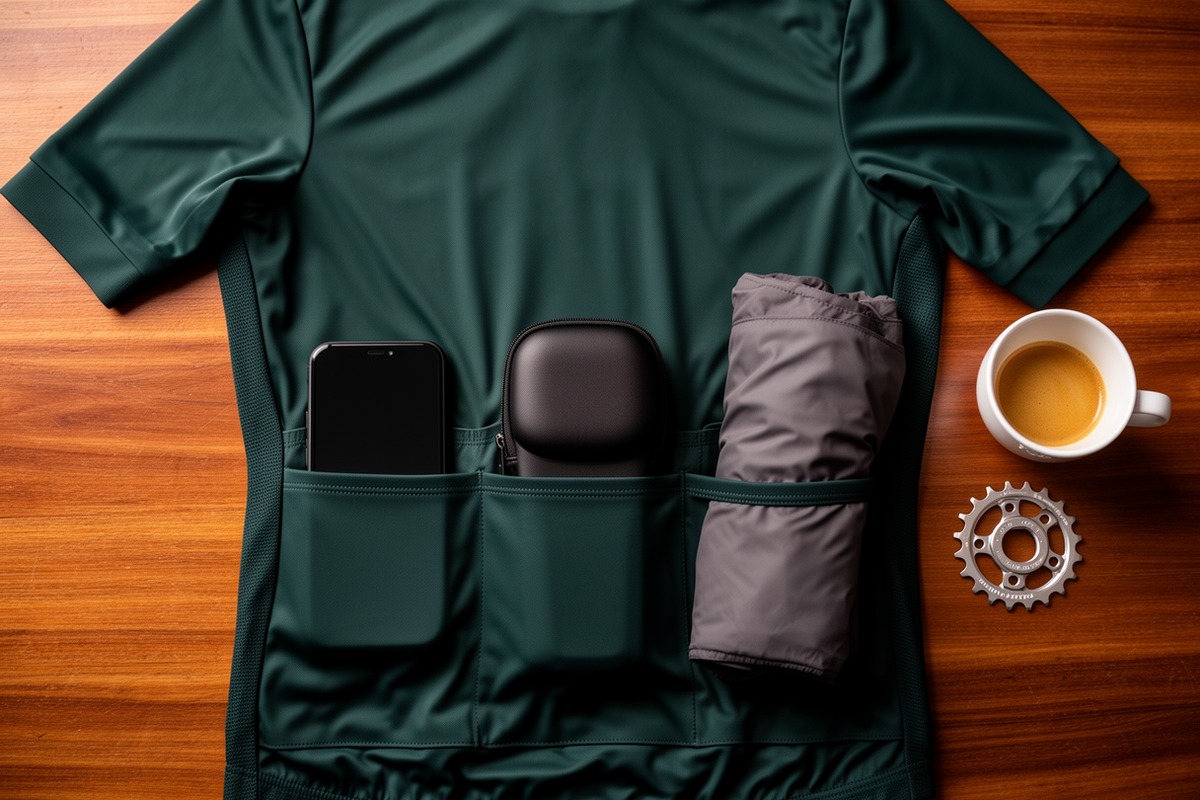
A road jersey gives you three pockets and no more. That constraint is the whole point. Panniers and a saddlebag will happily swallow everything you own, which is exactly why a café ride packed the panniered way feels less like a ride and more like a small logistics operation. The three-pocket limit forces a decision most riders never actually make on purpose: what do you genuinely need for two or three hours, a flat tire’s worth of trouble, and one espresso at the turnaround?
Here is how the space tends to sort itself out once you stop carrying things out of habit.
The left pocket: the stuff you hope stays put
The left pocket is for what you carry and never want to touch. On most rides that means the repair layer — one spare tube, two tire levers, and a way to put air back in. A CO2 inflator and a single cartridge is the compact answer; a stubby hand pump is the answer that never runs out and never fails in the cold. Pick one based on how far from home you ride and how much you trust a cartridge you bought eight months ago.
That is the honest core of self-sufficiency on a café ride, and it is smaller than most riders expect. The mistake is upgrading the flat kit into a full workshop. Carry the tools and spares that match your bike and route, and know how to use them before you need them. A chain tool and quick link can be worth bringing on rides where a broken chain would leave you far from home.
The one tool worth its pocket weight is a compact folding multi-tool, because the next roadside problem after a flat is often something rattling loose — a bottle-cage bolt, a saddle clamp that crept, or a cleat that needs a quarter turn before it ruins your knee.
Choose one with the hex sizes your bike uses and, where your hardware needs it, a T25 Torx. Check your own bike before you leave: disc-rotor bolts are often Torx, while many stem bolts still use hex keys. Anything beyond the tools and spares you know you need is weight you will carry for years and use twice.
The right pocket: the things you reach for
The right pocket is the working pocket — the one your hand finds without looking. Phone goes here, ideally in something that survives a sweaty back and a sudden downpour. A sandwich bag is not elegant, but it has saved more phones than any case sold as waterproof.
This is also where the café stop lives. A small roll of cash or a single card, because the good café at kilometer 40 is often the one with a hand-written “card machine down” sign taped to the till. A rider who has done the ride before carries the cash and stops thinking about it.
Food goes here too, and this is the pocket where people either overpack or forget entirely. For a ride with a café built into it, you need less than you think — the café is the feed station. One gel or a small bar covers the gap between “I am fine” and “I made a bad decision on that last climb.” Riders who bonk on café rides almost always did it in the ninety minutes before the café, riding slightly too hard on an empty stomach because the coffee was the plan for calories. The coffee is not the plan for calories.
The center pocket: layers and the weather you didn’t believe
The middle pocket is the deepest and the most secure, which makes it the layer pocket. A packable gilet or a wind shell folds down to about the size of a fist and changes a descent from teeth-chattering to pleasant. In shoulder seasons it is not optional. Even in July, a ride that starts at 6 a.m. and climbs anything will hand you a fast, cold descent before the day warms up, and a rider without a shell will be the one cutting the ride short.
The tell of an experienced café rider is that they carry the shell even on the mornings the forecast says they won’t need it. The forecast is describing the valley. You are going to be on a ridge, in the wind, moving at 45 kilometers an hour, wet with the effort of the climb you just did. Those are four different microclimates from the one the app measured.
What quietly leaves the kit
Spend a season paying attention and the kit gets shorter, not longer. The multi-tool with 23 functions gets replaced by the one with eight. The second spare tube goes back in the drawer once you trust your tires and your repair. The dedicated saddlebag disappears because everything fits in three pockets, and three loaded pockets ride better against your back than a bag swinging off the rails.
What stays is a short, boring list: fix a flat, tighten what rattles, pay for the coffee, add a layer, eat one thing. Everything else is either fear or momentum, and a café ride is supposed to be the opposite of both.
This is a Cadence & Crema evergreen guide. Kit lists are personal — if yours has a hard-won item ours skips, or a rule we got wrong, that’s the kind of correction worth a reply.