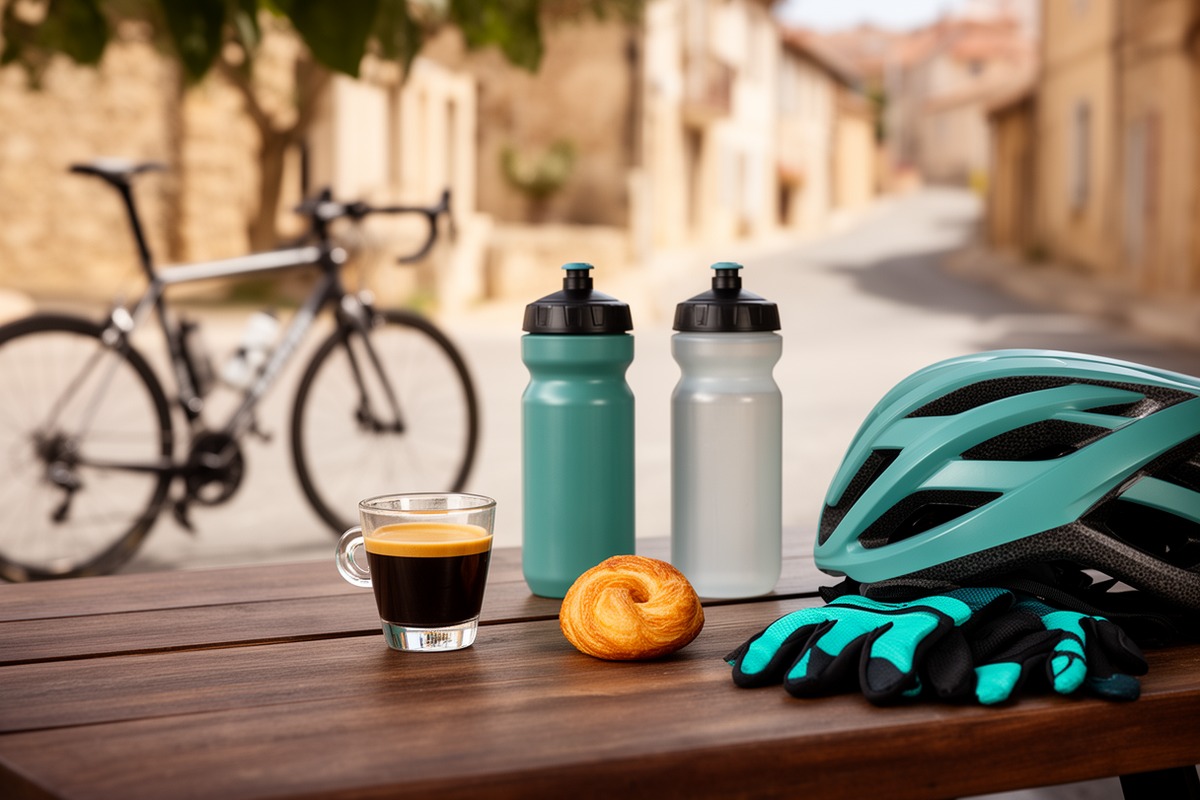
Our first guide on coffee and early rides covered the cup before you clip in: roast level, brew method, and the timing that gets caffeine working while the road is still quiet. That solves the opening hour. It does not solve a five-hour day.
By the far end of a long loop, the useful question is no longer Did I drink coffee this morning? It is What do I need before the return leg—fuel, water, caffeine, or some combination of the three?
That is the second-half problem. It starts with knowing what the first cup can and cannot do.
The first cup is a start, not the whole strategy
Caffeine does not simply vanish after an hour or two. Blood levels usually peak within roughly 30 to 120 minutes, and the average half-life is measured in hours, not minutes. Genetics, medications, habitual use, pregnancy, and even the time of day can change that window. The International Society of Sports Nutrition’s position stand is useful on the central point: caffeine can help endurance performance for many riders, but response and timing vary.
So why can a rider still feel flat three hours after a pre-ride espresso? Often because caffeine was never the main problem. Long rides consume carbohydrate, fluid, and attention. A larger cup before departure may raise the dose, but it cannot replace eating and drinking during the ride—and it does not guarantee either a later benefit or a harder “crash.”
A second coffee can be useful for some riders. It should be treated as an addition to a fueling plan, not the plan itself. Count what you already drank, consider how sensitive you are, and remember that an afternoon dose may still be active at bedtime.
The café stop is a feed station that serves espresso
Newer long-distance riders often treat the café as a reward: the ride is the work, and the coffee is the prize at the end of the hard part. Riders with a few centuries behind them tend to treat it as infrastructure. The café at the far point of the loop is a chance to eat, drink, refill bottles, and let the effort settle before turning home.
Coffee can sit on top of that. If you want caffeine for the return leg, drinking it near the beginning of the stop gives it a small head start, but a ten-minute difference is not magic. It may begin taking effect after you roll out and reach its strongest point later. The food and fluid you take alongside it are at least as important.
Choose something familiar and easy to digest. Refill before leaving. The best café order is the one that helps you ride home, not the one that looks most impressive beside the bike.
Espresso contributes fluid—but it is not a bottle refill
Coffee is not automatically dehydrating in the way old ride lore sometimes claims. Research reviews find that moderate caffeinated drinks still contribute to daily fluid intake for most regular users. The practical issue at a café stop is simpler: an espresso is tiny.
A sixty-milliliter double cannot replace the much larger amount you may have lost while climbing in summer heat. Enjoy the coffee, then drink water and refill your bottles. On a hot route, know where the next reliable water stop is rather than assuming another tap will appear.
The same distinction matters when riders talk about “bonking.” A true bonk is usually associated with running low on available carbohydrate; dehydration and heat strain can make the fatigue worse. If the return leg is falling apart, another espresso may sharpen attention, but it cannot refill glycogen or a dry bottle.
None of this is a medical prescription. It is a reminder to keep caffeine in its proper place: a potentially useful performance tool layered over adequate food and fluid, never a substitute for either.
The return leg and the second-espresso question
With an hour left, a second café can make one more coffee tempting. Whether it helps depends on the rider, the hour, the total caffeine already consumed, and what the stomach will tolerate.
A short espresso may feel easier than a large milk drink late in a hard ride, but that is preference, not a universal rule. Some riders handle both. Others sleep badly after an afternoon coffee or find that any late caffeine makes the stomach less cooperative. If you are unsure, the long event is not the day to test it.
Race day gets the same rule as part one: nothing new. Do not discover your response to a second espresso, an unfamiliar pastry, or a new single-origin with eighty kilometers still to ride. Test the routine on an ordinary training loop first.
When the café is not there
Some of the best routes go where cafés do not: a bikepacking overnight, a remote gravel loop, or a dawn start before anything opens. A compact brewer can make sense when the route already includes hot water, a stove, grounds, and time to stop.
The standard AeroPress is portable compared with a countertop brewer, but it is not weightless and it is not a complete coffee system by itself. For a normal road loop, carrying one is unnecessary. For a camp or trailhead stop where brewing is part of the plan, its durability and simple cleanup can earn the space in a bag. Riders prioritizing the smallest travel setup should compare it with purpose-built compact versions before packing.
The short version
- Pre-ride cup: useful, but its effects vary and it cannot carry the fueling plan by itself.
- Café stop: treat it as infrastructure—food, water, bottles, then coffee if it suits you.
- Hydration: espresso counts as fluid, but the serving is far too small to replace a bottle.
- Bonking: think carbohydrate first; dehydration and heat can compound the problem.
- Return leg: consider total caffeine, sensitivity, stomach comfort, and sleep before ordering another.
- No café on route: carry a brewer only when the rest of the brewing setup already makes sense.
Cadence is rhythm; crema is proof of care. On a long day, the care is not in making the second cup bigger. It is in knowing what problem you are actually trying to solve.
This is part two of a Cadence & Crema coffee-and-cycling guide—part one covers the pre-ride cup. Got a café-stop rule we missed, or a return-leg coffee that ended your night? That is the kind of correction worth a reply.